Emergence of Polarization and Marginalization in Online Education System of Bangladesh Due to COVID-19: Challenges and Policies to Ensure Inclusive Education
Hamid, M. M., Alam, T., Rabbi, M. F., Hasan, K., Kuzminykh, A., & Amin, M. R.
Design, User Experience, and Usability (DUXU), HCI International 2021, LNCS 12780, Springer · 2021
When COVID-19 forced Bangladeshi universities online almost overnight, not all students were affected equally. Surveying 184 university students, we found the student body polarized into two starkly different socio-economic clusters, and identified female and rural students as emerging marginalized groups. We propose an inclusive design policy with three action plans to reduce the divide.
The problem
Before COVID-19, online learning was almost non-existent in the educational institutions of Bangladesh. Unavailability of Internet and proper devices, lack of training, and institutional unwillingness kept online education rare — so when the pandemic forced a hasty transition from face-to-face teaching, institutions struggled enormously, and existing socio-economic disparities among students became even more pronounced.
We use "polarization" to mean the division of students into groups based on demographic and opinion differences, and "marginalization" for when a polarized group is further ostracized by deprivation of certain amenities.
What we did
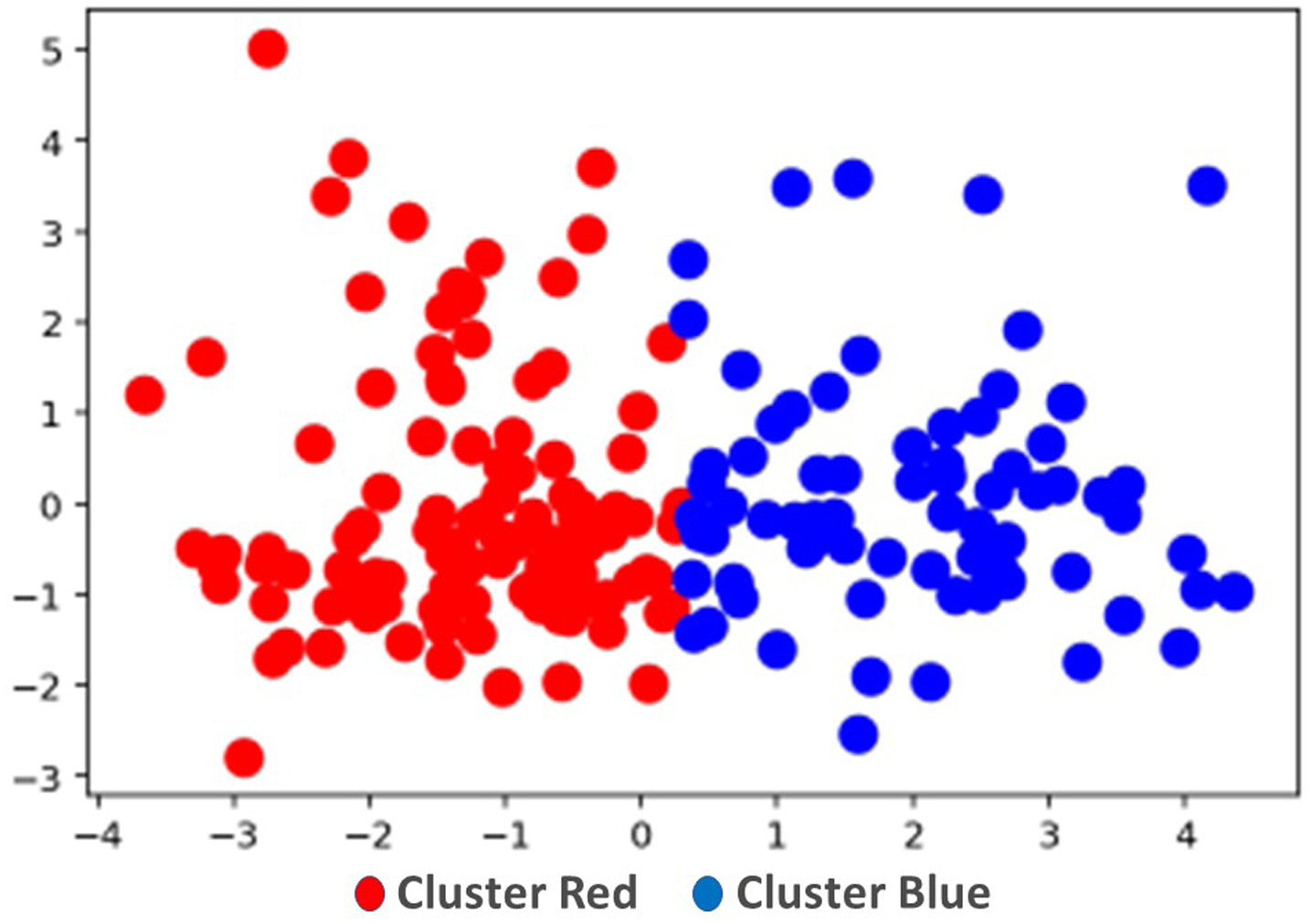
We surveyed 184 Bangladeshi university students participating in online classes since the lockdown and analyzed the responses two ways. First, unsupervised clustering: each student's response was represented as a vector of 17 demographic, device, and Internet-access attributes, and divided into clusters using Principal Component Analysis and K-means. Second, feature-specific statistical analysis: t-tests comparing student groups split by gender, locality, and Internet connection type. We complemented the survey with key informant interviews (KIIs) to hear students' real-life experiences.
Key results
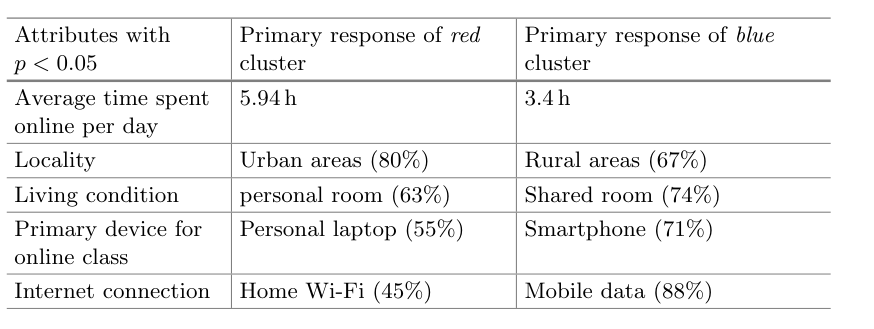
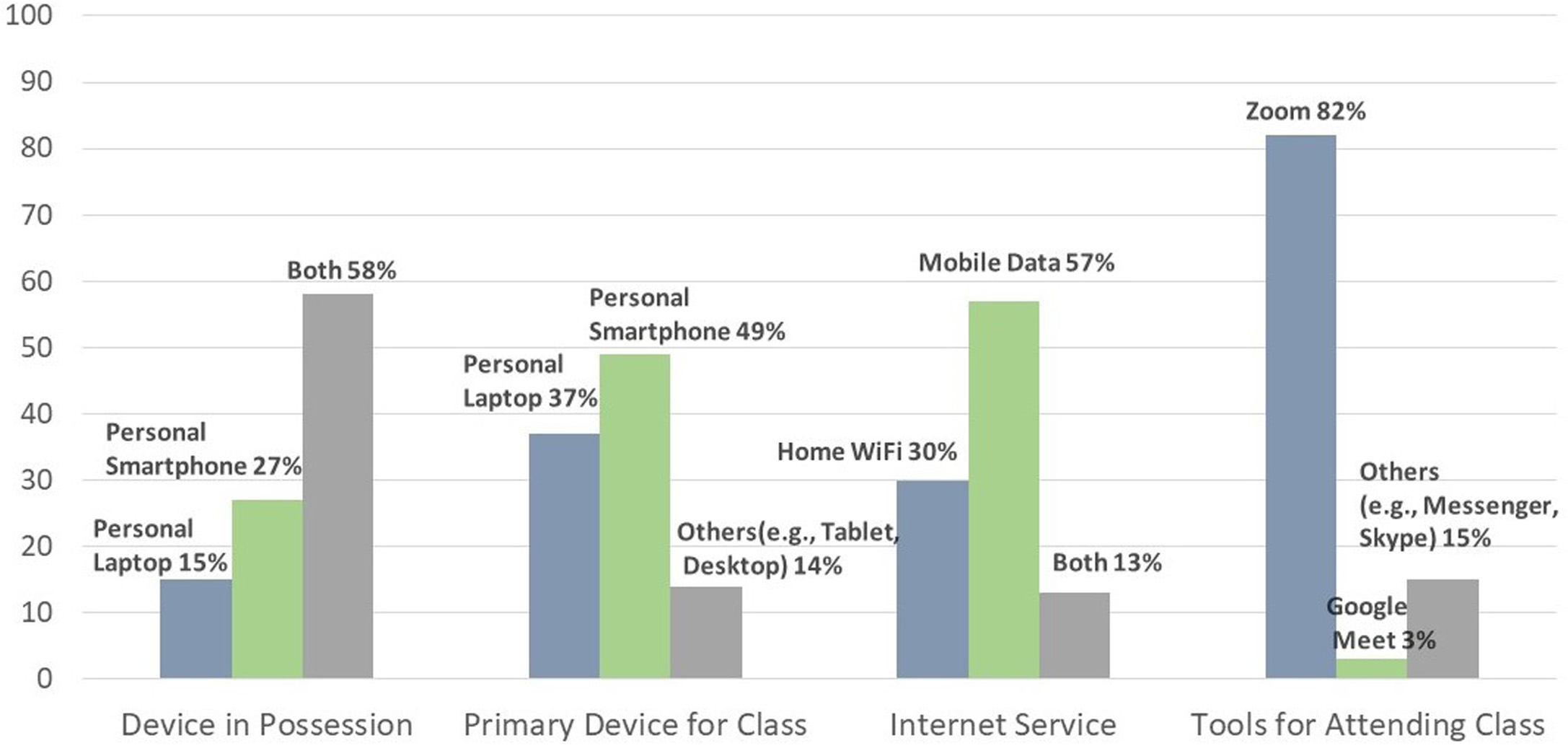
- Clustering revealed two polarized groups: a 112-student "Red" cluster — predominantly urban, home Wi-Fi, personal laptops, personal rooms, 58% satisfied with online classes — and a 72-student "Blue" cluster — mostly rural, shared rooms, smartphones as the primary class device (71%), mobile data for Internet (88%), with 79% dissatisfied with their online class experience.
- Among Blue-cluster students, 77.78% said they cannot afford the Internet bills for online classes, and 87.8% were dissatisfied with their Internet service.
- Feature-specific analysis identified two emerging marginalized groups: female students (more likely to share a room, 66.67%, and receiving less family cooperation for online study) and rural students (smartphone-dependent, suffering Internet speed and cost problems).
- KIIs echoed the statistics — one student walked 2 km to a village market to find mobile network coverage and attended classes inside a relative's shop.
- We propose three action plans: (1) subsidized mobile Internet packages targeted at marginalized student groups, (2) an asynchronous online education system so participation doesn't depend on live connectivity and electricity, and (3) low-bandwidth teaching materials (text/image discussion boards, optimized video lectures, mobile-friendly platforms).
From the paper