Design and Development of an ICT Intervention for Early Childhood Development in Minority Ethnic Communities in Bangladesh
Hamid, M. M., Alam, T., & Rabbi, M. F.
In Computationally Intelligent Systems and their Applications, Studies in Computational Intelligence 950, Springer · 2021
In Bangladesh's minority ethnic communities, children are often raised by local beliefs and traditions rather than scientific early childhood development (ECD) practices. We designed a smartphone application that helps indigenous parents monitor their children's mental and physical development — designed with, and evaluated by, members of the communities themselves, and iteratively redesigned based on their feedback.
The problem
Early childhood development encompasses cognitive, physical, and socio-emotional growth, which is largely absent as a practice in the minority ethnic groups of Bangladesh; local beliefs and traditions guide child-rearing instead of scientific methods, compromising many indigenous children's physical and mental well-being.
What we did
The research proceeded in three stages. First, in collaboration with the Department of Anthropology of Shahjalal University of Science and Technology, we ran focus group discussions and key informant interviews (with schoolteachers, midwives, indigenous chiefs, and indigenous mothers) to understand the communities' expectations. Second, we developed a smartphone application based on that qualitative data: an ECD activity checklist organized by age level and development category, with video demonstrations and audio in place of text for low-literate users. Third, we deployed the application among indigenous users, collected feedback on UI/UX, navigation, contents, and adaptability, and revised the interface accordingly.
Participation was completely voluntary and unrewarded, we worked with translators, no children participated, and we prioritized the communities' cultural sanctity throughout.
Key results
- The video contents worked: 78% of indigenous mothers and 82% of indigenous men understood the video content, and 75% and 80% respectively could relate the videos to the ECD checklist activities.
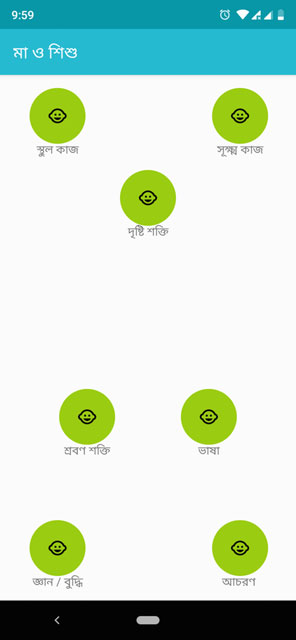
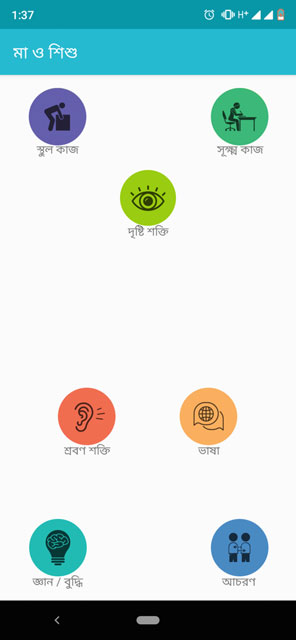
- Participants preferred animated content over text and responded positively to monitoring their children's growth with a smartphone app — but the mostly low-literate participants struggled with navigation on the original text-labeled homepage.
- Redesigning the homepage with distinctive, representative icons for each category fixed the problem: in the follow-up study, the homepage was comprehensible and the icons helped participants understand the app's contents.
From the paper